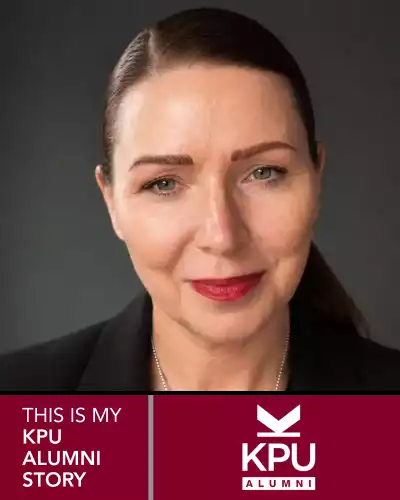
TANIA ROSIER (She/Her)
Née DahlCriminology - 2010
What brought you to KPU and your program of study?
In 2004, as a mother of five children, I found myself wondering how I was going to create a better future for my family. With only a Grade 12 equivalency and years away from formal education, university felt out of reach. Everything changed when I saw a full-page advertisement for Kwantlen Polytechnic University in my local newspaper. Curious, I made a phone call and met with a counsellor the following week. She helped me see that higher education was possible through flexible class schedules, small class sizes, and support for mature students with families. Through aptitude testing, I discovered that Criminology aligned with my interests and strengths, and I enrolled the following January. What once felt impossible became possible with one conversation and one decision to believe in myself. In my first semester, I earned a 3.0 GPA, proving that it is never too late to pursue your dreams.
Can you briefly describe your current position and your main day to day responsibilities?
As a Justice Interviewer with the Family Justice Service Division of the Ministry of Attorney General, I provide legal information and support to clients in person and over the phone regarding family law matters, including separation, divorce, guardianship, and parenting arrangements. Guided by the Family Law Act and Divorce Act, I ensure that the best interests of children remain the central focus of every interaction. My role also involves screening for risks of harm to children and domestic violence, assisting clients with protection order applications, and connecting them with legal advice and community resources. Through this work, I have developed strong communication, conflict resolution, and client-support skills. I am currently preparing for the next stage of my career as a Family Justice Counsellor where I hope to further support families through mediation and collaborative dispute resolution processes.
Which skills, knowledge, or experiences from KPU have been most valuable in your career so far?
My studies at KPU provided me with a unique combination of breadth and depth of learning that continues to shape my professional practice every day. The critical thinking skills I developed across a wide range of coursework, combined with deeper learning in law, sociology, and psychological explanations of human behaviour, informed my approach to interviewing individuals about their circumstances. This education taught me to remain curious, to listen carefully, and to support clients in exercising their own agency when making decisions for themselves and their families.
The criminological theories and explanations of behaviour I studied increased my awareness of domestic violence and the profound impacts of intimate partner violence on individuals and families and society as a whole. Learning about adolescent development and adult learning also strengthened my ability to understand how people process information during times of crisis, allowing me to adapt my communication and support strategies accordingly.
Perhaps most significantly, my studies in indigenous criminology deepened my understand of Truth and Reconciliation in ways that i do not believe would have been possible in a larger institutional setting. The respect, honor, and interconnected learning woven throughout the program continue to influence how I engage with clients today. I carry these lessons with me in every interaction, and I am deeply grateful for the opportunity to have learned this material in such a meaningful way from accessible and dedicated instructors.
What advice would you give current KPU students who want to build a successful career after graduation?
My advice to current KPU students is to never stop learning and never let anyone else define your limits. Stay curious, take advantage of opportunities to gain practical experience, and build meaningful relationships with your instructors, classmates, and professionals in your field and in your community. Success after graduation is not only about academic achievement - it is also about developing strong communication skills, critical thinking, adaptability, and a willingness to keep growing throughout your career and your life.
Seek out volunteer positions, internships, research opportunities, or part-time work that allows you to apply what you are learning in real-world settings. These experiences can help you build confidence, clarify your career goals, and create valuable professional connections. Don't be afraid to ask questions, seek mentorships, and step outside your comfort zone. Some of the most important growth happens when you challenge yourself with new experiences.
Most importantly, remember that career paths are rarely linear. Life may present obstacles, setbacks and unexpected detours, but those experiences can become some of your greatest teachers. After being told I would never walk, work, volunteer, or return to university following a traumatic brain injury, I learned that resilience, determination and a positive mindset can carry you further than you ever imagined. Nothing is impossible if you see life as happening for you and not to you. Stay focused on your values, remain committed to lifelong learning, and embrace every opportunity to grow. The relationships you build, the conversations you have, and the wisdom you gain along the way are just as important as the destination.