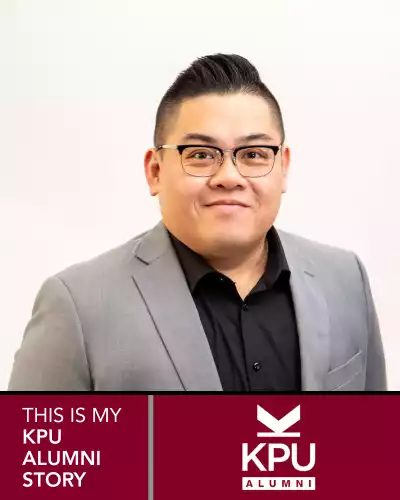
KELVIN WU
Criminology - 2015
What brought you to KPU and your program of study?
When I enrolled, KPU was still Kwantlen University College, and the Richmond campus was honestly a big part of why I chose it. It was convenient and easy to get to. But beyond location, Kwantlen had a solid range of Criminology courses, which was the field I was planning to major in at the time.
Can you briefly describe your current position and your main day to day responsibilities?
Right now I'm wearing a few hats, but they all revolve around Canadian immigration. My main role is Senior Immigration Advisor for faculty and staff under Central HR at UBC, where I advise university administrators at all levels, from HR assistants to department heads and Deans, on navigating the Canadian immigration system for incoming faculty and senior executive appointees.
On the side, my partner Vanessa and I co-own and operate Loughlin Wu Immigration Inc., a boutique Canadian immigration consultancy. We are both Regulated Canadian Immigration Consultants, so it is very much a shared professional venture. Our practice focuses primarily on corporate immigration, including employer compliance and the recruitment and retention of skilled foreign workers. We also handle individual and family files, covering permanent residence applications through economic immigration pathways, family sponsorship, and citizenship applications.
I also teach as an Adjunct Instructor in the Graduate Diploma in Immigration and Citizenship Law at the Faculty of Law, Queen's University.
Beyond that, I volunteer on the Employer Advisory Group with the Immigrant Employment Council of BC, and I sit on the Advocacy Committee with the Canadian Association of Professional Immigration Consultants.
Which skills, knowledge, or experiences from KPU have been most valuable in your career so far?
One of the biggest things KPU gave me was the ability to work with people and find common ground. So much of what I do now, in all of my roles, depends on building and maintaining stakeholder relationships, and that foundation really started at KPU. The small class sizes made a big difference. They created a setting where you were actually engaging with your peers rather than just sitting in a lecture, and that kind of peer-to-peer interaction is where I really developed my communication skills. Those same skills are ones I rely on every single day in my professional life now.
That was also supplemented by my early work experience as a Border Services Officer with the CBSA, which was actually an opportunity I found through a career recruitment event hosted by Kwantlen. It was a great example of the school opening doors beyond just the classroom, and that role gave me hands-on experience that ended up being foundation to the immigration field I work in today.
What advice would you give current KPU students who want to build a successful career after graduation?
Take advantage of the access you have to your professors and your peers, and be intentional about building those relationships. Very little in today's society gets done in isolation, and the connections you make while you are still in school can carry a lot of weight as you move forward in your career.
And yes, group work is painful, and it does not get any less painful when it gets rebranded as a "project" in the workplace. But the ability to collaborate, communicate, and navigate different working styles is something you genuinely cannot pick up from a textbook. That only comes from being thrown into it, which is exactly what the learning environment at a school like KPU is designed to do. Make the most of it while you are there.